A study led by the UB and the ICM-CSIC reveals that increases in water temperature accelerate reproduction in this key species, putting its survival at risk.
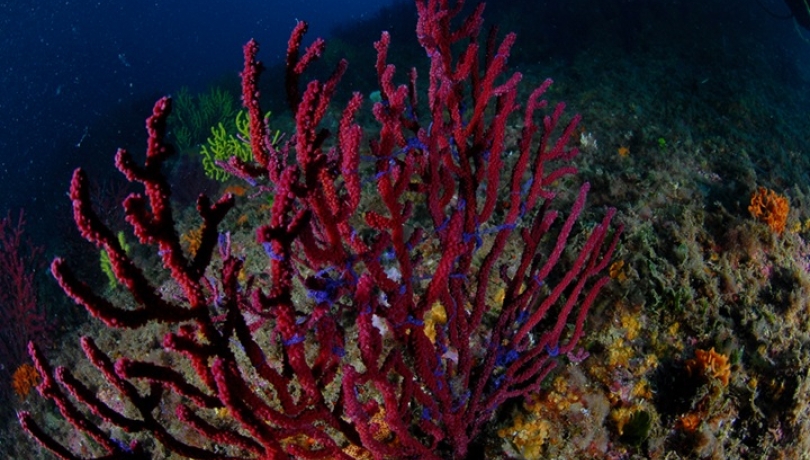
Climate change is accelerating the arrival of spring's warmer temperatures, and this phenomenon affects the conservation of many species. Now, a study published in the journal Global Change Biology reveals how an increase of two degrees Celsius in temperature makes the reproductive process of the red gorgonian advance by two weeks, a temperate-water species with an important ecological role, as it provides structure and refuge and, thus, favors the biodiversity of the seabed.
The work highlights the decisive role of global warming, which advances the arrival of spring, as a determining factor of the changes in the biological cycles of marine organisms that live in coastal ecosystems. The main authors of the study are Núria Viladrich and Cristina Linares, from the Faculty of Biology and the Biodiversity Research Institute of the University of Barcelona (IRBio), and Joaquim Garrabou, from the Institute of Marine Sciences (ICM-CSIC).
Phenological alterations in marine ecosystems
One of the most direct effects of climate change is the alteration of the natural cycles of living beings. These changes, known as phenological, alter the calendar of critical biological processes (reproduction, migration, distribution, etc.) in organisms on a global scale, as a response to new environmental conditions.
"Global warming is deeply altering biodiversity, but until now most research has focused on the direct impacts of extreme temperature episodes," details Professor Cristina Linares, from the Department of Evolutionary Biology, Ecology and Environmental Sciences of the UB.
"It is becoming increasingly evident that climate change is advancing the entry of the warmer temperatures of spring in many ecosystems," details the researcher. "The phenological changes associated with climate change decisively affect the conservation of populations, but, despite the scientific interest they have aroused in recent years, their effects on marine species are still little known."
Warmer spring temperatures arrive earlier and earlier due to climate change and advance the moment of reproduction of a marine species that is decisive in the structure and biodiversity of coralligenous bottoms. The sexual reproduction of the red gorgonian (Paramuricea clavata) is an essential process to generate populations with more genetic diversity. The phenomenon takes place in spring, when the colonies release sexual gametes (eggs and sperm), which, through external fertilization, give rise to small larvae that settle on the bottom to form new colonies.
Less energy and more larval mortality
"The study reveals that a two-degree increase makes the moment of larval release in the gorgonian advance by two weeks. This discovery has been confirmed through observations at sea in the Montgrí Natural Park, the Medes Islands and Baix Ter, and with laboratory experiments," details Núria Viladrich, Beatriu de Pinós postdoctoral researcher and first author of the study.
"This two-week advancement of the reproduction event entails negative impacts on this species: it reduces larval biomass, which makes them have less energy, increases the mortality of the larvae and causes them to have less success when fixing themselves to the seabed, which can limit the recovery of the species in the face of mass mortality events," warns Viladrich.
Previous studies had already revealed the negative impact on the conservation status of P. clavata populations in the face of extreme climatic events caused by climate change, mainly heatwaves.
"The negative impact of the temperature increase on the reproductive cycle, together with the recurrence of heatwave impacts, is accelerating the collapse of red gorgonian populations," points out Joaquim Garrabou, from the Institute of Marine Sciences (ICM-CSIC).
"In species that act as architects of the seabed, it is urgent to monitor phenological changes because they can compromise the viability of populations and affect the biodiversity of marine ecosystems," the researchers conclude.