The ICM-CSIC joins the “Òh!pera” project, promoted by the Gran Teatre del Liceu, the Barcelona City Council’s Department of Culture and Creative Industries, and the Disseny Hub, in collaboration with design schools.
The Institute of Marine Sciences (ICM-CSIC) has joined Òh!pera, a pioneering project that redefines the traditional concept of opera by embracing innovative formats that connect with 21st-century sensibilities. The initiative combines experimentation, interdisciplinarity, and creative risk to give voice to new talents and artistic languages, in a setting designed to spark surprise and reflection on contemporary issues, including science.
Within the framework of this collaboration, one of the micro-operas of the 2027 edition will be inspired by the sea and by the research carried out at ICM-CSIC. To make this possible, the librettist and the composer are working closely over these months with the centre’s scientific and technical staff. Through dialogue and joint experimentation processes, the foundations are being built that will inspire both the micro-opera’s libretto and the music itself.
“This project stems from a shared interest among all the institutions involved in fostering dialogue between disciplines, connecting with the sensibilities of the contemporary audience and focusing on current issues, including those related to science,” says Elisabetta Broglio, the initiative’s strategic director and coordinator of the Mar de Ciència Programme, of which this project forms part.
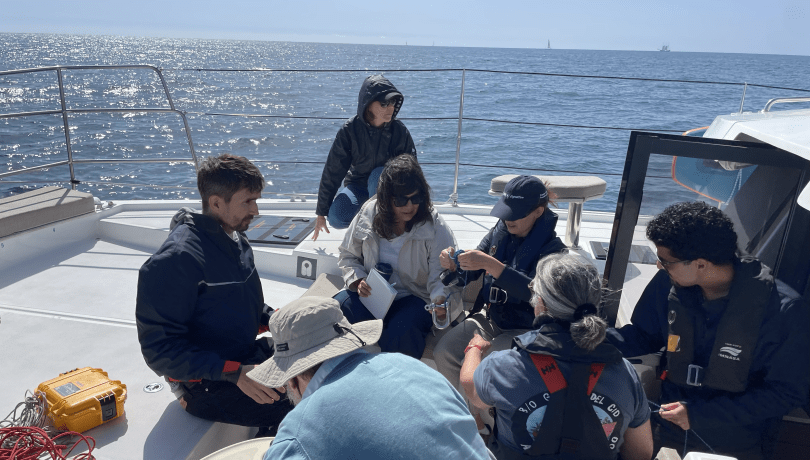
During the first few weeks of work, librettist Aina Tur and composer Sílvia Lanao visited the ICM-CSIC facilities, spoke with the centre’s staff and took part in a sea trip. This experience allowed them to observe and record data using oceanographic instruments commonly employed in coastal sampling, thereby incorporating scientific practice into the creative process.
Thanks to a grant from the Catalan Foundation for Research and Innovation (FCRI), the ICM-CSIC will document this interdisciplinary process in a video featuring a ‘making-of’ of the creation. In addition, a volume will be produced containing the opera libretto, texts on the creative process and informative content on the scientific themes that form the basis of the micro-opera.
“With this project, the science carried out at the ICM goes beyond the centre’s walls to spread and become part of the cultural fabric, turning into a shared experience with the public,” highlights Vanessa Balagué, one of the project’s scientific curators.
Finally, Kaiene Griffell, the project’s executive producer at the ICM-CSIC, emphasises that the initiative offers scientific and technical staff an opportunity to engage with musical language and artistic methodologies.
All in all, the initiators of this collaborative project believe that integrating artistic disciplines into the world of research and sharing methodologies—both artistic and scientific—can be a highly enriching experience, and that these discussions may give rise to new lines of research or methodologies.
Research and technical staff at the ICM involved in the dialogues with the librettist and the composer: Andrea Cabrito, Marta Carretón, Eve Galimany, Jordi Grinyó, Maribel Lloret, Paula López, and Bryan Nicolás.