The study, resulting from a collaboration among several CSIC institutes, Alimentta, and the Pablo de Olavide and Santiago de Compostela universities, quantifies for the first time the greenhouse gas emissions of the entire mussel food supply chain in Spain. The research involved the participation of the Institut de Ciències del Mar (CSIC), based in Barcelona.
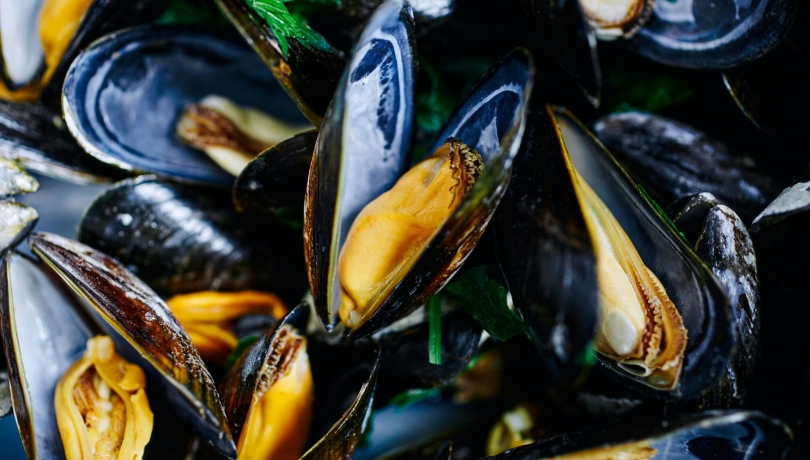
A multidisciplinary team composed of experts from various Spanish research centres has published the first study to comprehensively quantify the carbon footprint of the mussel food supply chain in Spain, covering all stages from aquaculture production to final consumption.
The article, published in open access in Resources, Conservation and Recycling, analyses the climate impact, in terms of greenhouse gas (GHG) emissions, of the main commercial presentations of mussels (fresh, frozen, and canned), integrating data on national production, trade, industrial processing, and transport (international, national, and intra-provincial).
The study estimates that the mussel food supply chain generates 287.8 thousand kg CO₂eq per year, resulting from the combined contribution of aquaculture production, industrial processing of the different product formats —fresh, frozen, and canned— and transport, among other factors.
These findings show that although mussels are among the marine proteins with the lowest environmental impact at the production stage, their carbon footprint increases significantly due to the degree of processing and the commercial flows associated with the product.
Canned products show the highest environmental impact
Emissions associated with domestic consumption reach 190.1 thousand kg CO₂eq per year, equivalent to 6.3 kg CO₂eq per kg of edible product (without shell). However, the impact varies substantially depending on the product format. The results indicate that mussels in escabeche (pickled sauce) account for the highest impact, whereas frozen mussels show the lowest.
The frozen format presents the lowest environmental impact due to transport without shell and less intensive industrial processing compared to other formats, while canned products —the most widely consumed presentation— generate a higher footprint per kilogram.
Regarding national production, Galicia accounts for 99% of Spanish mussel production; however, only 25% of the available fresh mussels are destined for direct consumption within Spain, while the remainder is exported, increasing the carbon footprint associated with final consumption.
“To put these emission figures into context, it is useful to consider the footprint of other commonly consumed foods,” explains Joan Moranta, researcher at the Balearic Oceanographic Centre (IEO-CSIC). “Beef shows values well above those of mussels, on the order of tens of kg CO₂eq per kg. Pork falls within intermediate ranges, around 7 kg CO₂eq per kg. Some fish species, such as hake, may be close to 4.4 kg CO₂eq per kg. Mussels stand out as a marine protein with moderate emissions, but with high sensitivity to the level of industrialisation and commercial flows,” the scientist adds.
Key measures to reduce impact
The study identifies several recommendations to reduce environmental impact, including promoting the consumption of nationally produced fresh mussels; improving efficiency across the production chain; optimising commercialisation processes; and implementing more sustainable practices at all stages, from depuration to final distribution. These measures aim to reduce energy consumption and GHG emissions, according to the research team.
“Mussels are a low-impact marine protein, but the current production and consumption model, based on industrial processing and complex commercial chains, considerably increases their climate footprint. Promoting the consumption of fresh and frozen mussels, and optimising logistical flows, offers a clear opportunity to reduce sectoral emissions,” concludes Pablo Saralegui, first author of the study and researcher at Alimentta and the Pablo de Olavide University.
“Optimising transport, using more sustainable packaging materials, or adopting technologies that minimise resource use and reduce emissions during mussel production and processing are specific practices that contribute to improving sustainability,” notes Montserrat Ramón, researcher at the Institut de Ciències del Mar (CSIC).
This publication, supported by the Daniel and Nina Carasso Foundation, is the result of a multidisciplinary collaboration among researchers from Alimentta, Pablo de Olavide University, the University of Santiago de Compostela, the Mediterranean Institute for Advanced Studies (IMEDEA, CSIC-UIB), the Institut de Ciències del Mar (ICM-CSIC), and the Balearic Oceanographic Centre (COB-IEO, CSIC).