The project, led by the Institute of Marine Sciences (ICM-CSIC), involves the collaboration of the Institute of Space Studies of Catalonia (IEEC), the company Radian, and the French research institute Ifremer.
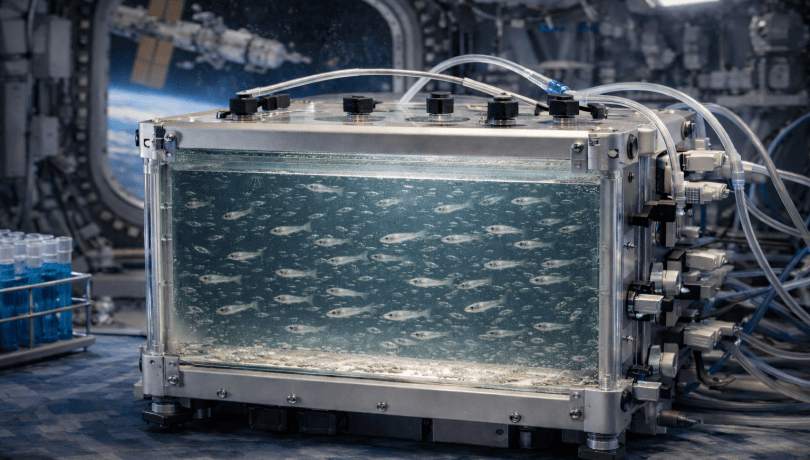
Last November marked the launch of SpaceGenFish, a pioneering project led by the Institute of Marine Sciences (ICM-CSIC), in collaboration with the Institute of Space Studies of Catalonia (IEEC), the company Radian, and the French research institute Ifremer. The project aims to demonstrate that farming fish in space could be a realistic way to provide fresh and healthy food for long-duration missions. The initiative is funded by the Spanish Space Agency (AEE) within a European Space Agency (ESA) programme.
The project focuses on the biological and epigenetic adaptation of fish under space conditions, to advance toward sustainable food systems in orbit. Its main objective is to understand how microgravity and radiation affect aquaculture species, and to determine whether they can adapt to an environment as extreme as that of the International Space Station (ISS).
Through a 15-day orbital experiment, the team will also analyze for the first time which epigenetic mechanisms—those that regulate gene expression without altering the DNA sequence—are activated in fish when they live outside Earth. This information is essential for the development of future food production systems in lunar or Martian bases.
The project stands out for its combination of marine science, space biology, and advanced engineering. For aquaculture to be viable under microgravity conditions such as those found in space, a fully autonomous system must be designed to keep the animals in suitable conditions, ensure environmental control, and enable the collection of reliable data throughout their stay in space.
This technology, developed jointly with the private company Space Applications Services NV/SA (SAS) and the SpaceGenFish team, opens up a new line of research that until now had been largely exploratory and that could mark a turning point in food production in isolated environments.
The project coordinator, Laia Ribas, researcher at ICM-CSIC, highlights the initiative’s transformative potential:
“This project allows us to make a very significant conceptual leap: we move from studying the effects of altered gravity on fish in terrestrial laboratories to observing them directly in space. Imagining aquaculture in space is no longer science fiction; we are now taking the first real steps. Understanding how the fish epigenome responds to such a different environment is key to ensuring fresh food for future missions. It is undoubtedly a pioneering project that breaks new ground.”
Juan José Ramos, researcher at IEEC at the Universitat Politècnica de Catalunya – BarcelonaTech (UPC), emphasizes that technological innovation is central to the project’s success:
“We are facing a complex challenge: creating a safe, stable, and fully autonomous system that allows fish to live in microgravity. The collaboration between space engineering and marine biology makes this project an exceptional opportunity to position Catalonia in an emerging field with great potential.”
Previous groundwork
SpaceGenFish builds on experience gained from previous studies in biology under altered gravity conditions. Ribas’s team has worked both in conventional laboratories and in unique infrastructures such as the Canfranc Underground Laboratory (LSC), which allows the study of certain cosmic effects in a deeply shielded environment. This background supports research that aims not only to understand fish survival in space, but also to identify adaptations that could be valuable for terrestrial aquaculture.
The collaboration with a leading French international research center, coordinator of the Lunar Hatch program under researcher Cyrille Przybyla, reinforces the international dimension of an initiative that could help define the foundations of future food production in extremely hostile environments.
The launch of the experimental module has not yet been finalized but is scheduled to take place within less than a year, as part of a mission that will also include other Spanish projects selected under the same ESA call. Ribas will be present at NASA facilities during the launch and will monitor the animals’ behavior in real time using remote monitoring systems. The experiment will employ state-of-the-art sequencing techniques to analyze the animals’ complete epigenome after their orbital stay.
Overall, the project’s impact extends beyond space research. Its results may provide valuable knowledge to improve the resilience and adaptability of fish in aquaculture, a sector that is key to global food security.