In this month’s “In Depth", we tell the story of our colleague Belén Alonso, who, within the framework of Awareness Month, recounts her career path, the challenges of oceanography in the 80s, and the importance of a gender perspective in current research.
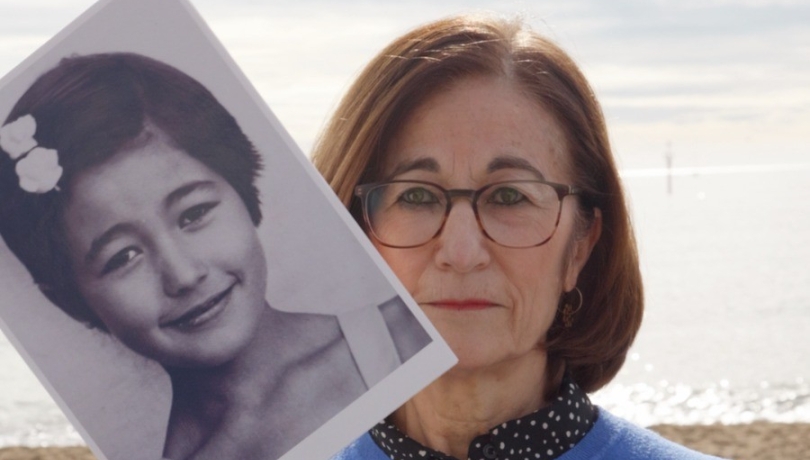
There are moments that map out a lifetime. For our colleague Belén Alonso, that moment occurred at the age of seven, in front of a beach in Santander. It was the first time she saw the sea. The vastness, the blue, and the constant rhythm of the waves were engraved on that young girl's retina. It was a foundational wonder. Decades later, that same curiosity would lead her to decipher the secrets of the ocean floor, becoming one of the key figures in marine geology in Spain. Today, from the perspective granted by a career dedicated to the geological study of the seabed and the sub-bottom hidden under the water, Belén reflects on a path that has been, in her own words, a "long-distance race."
The map of the invisible
Marine geology is, in essence, a labor of interpreting what cannot be seen. Belén trained at the Faculty of Geology of the University of Barcelona at a time when there was no family tradition or close role models.
"My parents weren't sure what this degree was for, but they trusted me," she recalls.
However, a trip on an oceanographic vessel during her studies was the ultimate catalyst. The sea was no longer just a holiday landscape; it was a physical archive to be deciphered.
Through her work, Belén has explored the seabed and sub-bottom where submarine mountains, volcanoes, valleys, and channels have been mapped. Her work in the study of geological risks—of fundamental interest for infrastructures such as fiber optic cables or gas pipelines—and paleoceanography has allowed us to understand the Earth's climatic past. But this knowledge has a cost that does not always appear in publications: time. Oceanographic campaigns require weeks or months of absence, a physical distance from home that, historically, has weighed differently on the shoulders of men and women.
Science in front of the mirror of equality
"The world needs science and science needs women," she states emphatically.
However, her career is a testament to the fact that this equality is still an ongoing construction. In the 80s, Belén was often the only woman on board oceanographic vessels. She learned to live in a masculinized environment.
One of the most critical moments of her career coincided with the completion of her doctoral thesis. Motherhood became a challenge.
"I had my first daughter while I was doing my thesis. It was a pause, and my work environment was not favorable, but I managed to finish it, passed the competitive examinations (oposiciones), and joined the ICM-CSIC to conduct research."
That act of tenacity was decisive, as was her family's support. Belén admits she was on the verge of quitting, a reality that still pushes many researchers today to leave science due to the lack of work-life balance and the burden of care that continues to fall mostly on women.
A message for the girl looking at the sea
When asked what she would say to the girl she once was, Belén does not speak of academic success, but of values.
"I would tell her not to set limits for herself, to have confidence in herself. That curiosity must be the engine of a lifetime."
For her, today's girls are the engines of the future and the hope for a better world.
For the researcher, quality science is not done alone. Marine geology has taught her that knowledge of the seabed and sub-bottom is a puzzle where tectonics, sedimentology, geomorphology, paleontology, and geochemistry must fit together through teamwork. But, above all, she emphasizes the importance of personal integrity: being a good person, humble, and respectful in a professional environment that often forgets these pillars.
In this period that connects Feb 11 (International Day of Women and Girls in Science) and Mar 8 (International Women's Day), the figure of Belén Alonso emerges as the role model she never had. Her story reminds us that, although the gender gap persists, the determination of those who refused to accept imposed limits has allowed new generations of female oceanographers to no longer sail alone. Belén retired knowing that the ocean still keeps secrets, but with the certainty that now there are more female eyes ready to discover them.