The initiative, led by ICM-CSIC, has enabled the testing of innovative approaches to mitigate impacts on high ecological value marine habitats through the reintroduction of more than 3,500 organisms — including gorgonians, Posidonia, and kelps — combining applied science, collaboration with the fishing sector, and social inclusion.
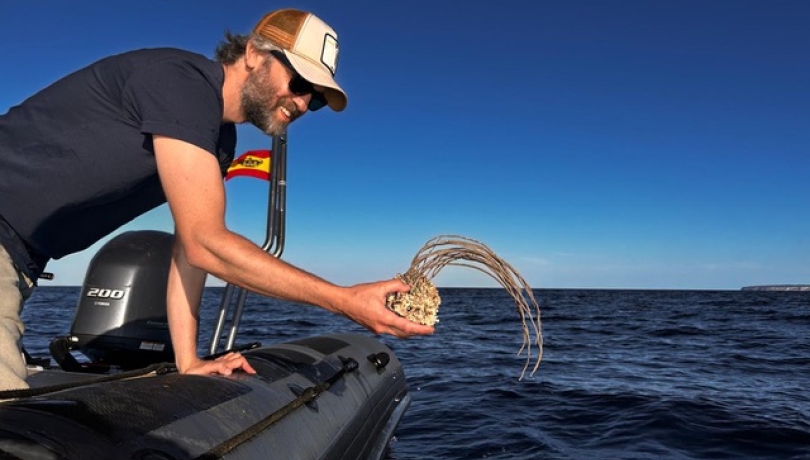
The CABALGA project, coordinated by the Institute of Marine Sciences (ICM-CSIC) in collaboration with the Galician organization Amicos and fishing guilds from Galicia, the Balearic Islands, and Catalonia, has completed its first phase with promising results in validating techniques aimed at the recovery of protected marine ecosystems. The actions carried out, also in collaboration with the Biodiversity Foundation of the Ministry for Ecological Transition and the Demographic Challenge, through the Pleamar Programme, and co-funded by the European Union through EMFAF (European Maritime, Fisheries and Aquaculture Fund), have helped mitigate impacts on vulnerable habitats and strengthen benthic biodiversity in areas of high ecological value. The results demonstrate the effectiveness of methodologies based on collaborative work to move towards more sustainable seabed management.
According to Blanca Figuerola, ICM-CSIC researcher and Principal Investigator of CABALGA:
“Results show that it is possible to mitigate pressures on key habitats through applied and collaborative scientific approaches. In addition, the project will validate ecological restoration techniques for their incorporation as mitigation and adaptive management tools in marine protected areas.”
Pilot actions in marine protected areas
Among the project’s main achievements is the reintroduction of more than 800 gorgonians, over 1,000 bundles of Posidonia oceanica, and around 1,700 kelp supports in particularly sensitive areas such as the Atlantic Islands of Galicia Maritime-Terrestrial National Park, the Cap de Creus Natural Park, and the marine environment of the Ses Salines Natural Park of Ibiza and Formentera. These actions have directly contributed to reducing the impacts of human pressures, strengthening benthic biodiversity, and increasing the resilience of vulnerable habitats to current environmental pressures, while allowing the assessment of the performance and viability of these techniques under real-world conditions.
According to Stefano Ambroso, ICM-CSIC researcher and project team member, “CABALGA demonstrates that active interventions in marine habitats are possible when scientific knowledge, local experience, and long-term planning are combined. The results obtained exceed our initial expectations and confirm the effectiveness of the applied methodologies.”
Science, fishing sector, and social inclusion
Beyond ecological results, CABALGA has consolidated an innovative model of collaborative conservation, based on cooperation between the scientific community, the fishing sector, and civil society. One of the project’s most distinctive elements has been the active participation of people with disabilities in scientific and technical tasks linked to seabed recovery.
“The social dimension of CABALGA is as important as the environmental one,” Ambroso highlights. “The involvement of people with disabilities not only brings undeniable human value, but also shows that marine science can and should be inclusive, generating real benefits both for ecosystems and for society.”
The project has also developed outreach, training, and awareness-raising activities, including workshops and educational initiatives related to marine habitat restoration, to foster a more informed and engaged public committed to marine protection.
Following its success, CABALGA has been renewed for an additional year and a half, during which its scope of action will expand to the Cantabrian Sea. This new stage will also include new partners, such as the Catholic University of Valencia and the National Federation of Fishing Guilds, and will focus on integrating artificial intelligence tools for the analysis and processing of scientific data.
“The continuation of the project will allow us to further validate these techniques and optimize decision-making through the use of new technologies such as artificial intelligence,” Ambroso concludes. “Our goal is to continue advancing towards more sustainable and participatory management of marine ecosystems.”
With its combination of applied science, community participation, and social inclusion, CABALGA is establishing itself as a benchmark in impact mitigation and in the development of tools for the restoration and sustainable management of marine ecosystems along the Spanish coast.