The research, which warns of the transformation of fish catches and fishing income due to climate change, has been awarded in the Environmental and Earth Sciences category.
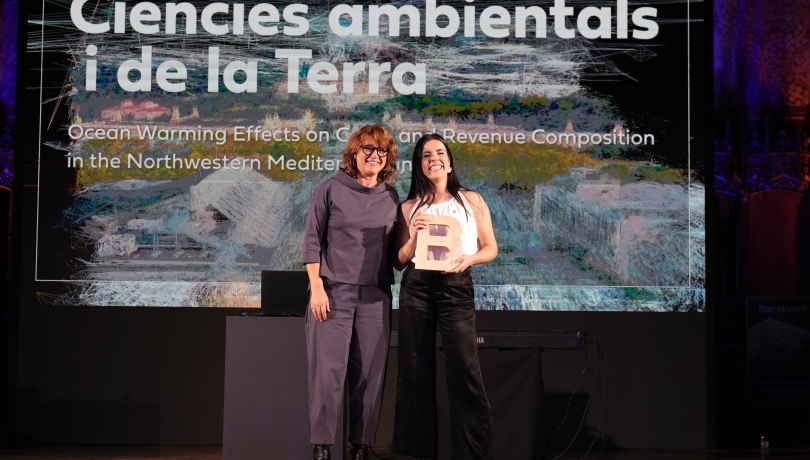
The scientific excellence of the Institute of Marine Sciences (ICM-CSIC) has once again been a protagonist in the cultural and academic landscape of the Catalan capital. The 2025 Ciutat de Barcelona Prize in the Environmental and Earth Sciences category has distinguished a study led by the Institute in collaboration with the AZTI Marine and Food Research Center and published in the journal Global Change Biology, which analyzes how the progressive warming of the Mediterranean Sea is altering fish catches and fishing income on the Catalan coast. These awards, presented annually by the Barcelona city council, aim to recognize quality creation, research, and production carried out in the city.
The jury particularly valued the research's ability to connect the climate crisis with direct repercussions on the fishing sector. The scientific article demonstrates how the tropicalization of catches—the increase in warm-water species to the detriment of colder-water ones—not only changes the marine ecosystem but also modifies the catches and income of fishers.
Scientific evidence of ocean transformation
The award-winning research highlights that the rise in Mediterranean temperatures in recent decades has caused changes in the composition of the marine community, with effects on catches and fishers' income. According to the data collected, catches of thermophilic species (which prefer warm waters) have multiplied, while species from more temperate or cold waters, historically fundamental to the Mediterranean diet and the local market, are in decline. This phenomenon is not just a biological data point but a reality that already affects the market price (llotja) and the daily work of fishers.
Lucía Espasandín, a PhD candidate at the ICM-CSIC and lead author of the article, highlights the importance of this recognition in making the effects of climate change on the coastline visible:
"Receiving the Ciutat de Barcelona Prize is an honor and an opportunity to bring to the table that climate change is not a future threat, but a reality. Our research shows that the loss of biodiversity and the change in the composition of catches have a real economic effect. This award encourages us to continue working to provide data that helps design urgent adaptation strategies for fishing communities."
The study not only analyzed the general evolution of catch composition and fishing income across the Catalan coast as a whole but also delved into the details of each fish market and fishing fleet. In the words of Francisco Ramírez, co-author of the study and senior researcher at the ICM-CSIC, "this approach allows us to go beyond an aggregated view and understand how the impact varies from one port to another."
Resilient fisheries management
Winning this award underscores the need to integrate science into public policy and natural resource management. The study establishes a solid foundation for understanding the changes already occurring in the fishing sector within a context of constant transformation associated with climate change. This scientific evidence can guide the decisions and adaptations that will need to be promoted to ensure the future viability of the sector. For Miquel Ortega, co-author of the study and senior researcher at the ICM-CSIC, "the collaboration between scientists and fishers thus becomes a key piece to ensuring the sustainability of the Mediterranean."
Marta Coll, co-author of the study and senior researcher at the ICM-CSIC, emphasizes the collective dimension of this recognition: "This award reaffirms the ICM-CSIC's commitment to science that has a direct impact on society. The warming of the Mediterranean is transforming catches and income, and this forces us to rethink our relationship with the sea from a perspective of sustainability and resilience. The research we have conducted is a wake-up call, but also a tool for management; we want this knowledge to serve to protect both marine ecosystems and the livelihoods of so many families who depend on them."
With this Ciutat de Barcelona Prize, the ICM-CSIC once again consolidates itself as a reference center in marine research, capable of translating the complexity of the ocean into the central debates of today's society and actively contributing to the future of a Barcelona that looks to the sea with determination, based on scientific knowledge and the will for transformation.