Researchers from the Institut de Ciències del Mar (ICM-CSIC) and the Universitat Catòlica de València (UCV) demonstrate, in a recent study, the value of marine collagen obtained from jellyfish bycatch for health and sustainability.
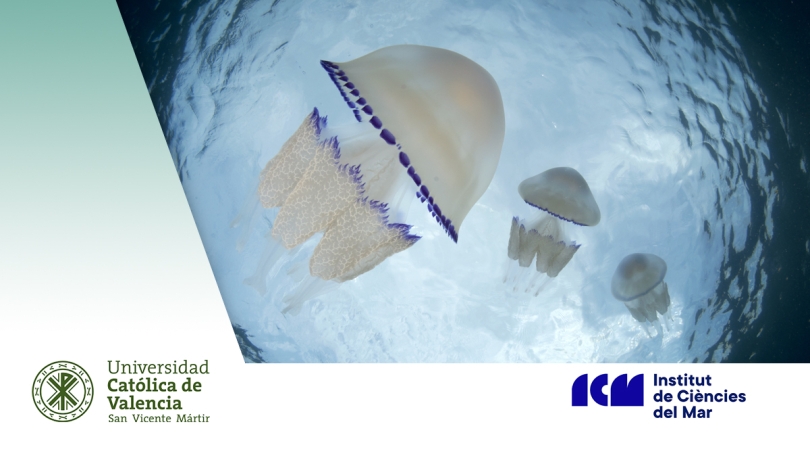
The Institut de Ciències del Mar (CSIC) and the Universitat Catolica de València, through the Institut Universitari d’Investigació en Medi Ambient i Ciència Marina (IMEDMAR-UCV), have concluded the project Jellyfish Collagen: An Innovative Mediterranean Resource in Blue Biotechnology (COLMED), an initiative demonstrating how jellyfish bycatch can be transformed into a strategic and sustainable resource.
Traditionally, jellyfish bycatch has posed a challenge for small-scale fisheries, increasing operational costs and generating underutilised biomass. However, the project’s findings show that this issue can be reframed as an opportunity: jellyfish represent an emerging source of collagen with broad applications in blue biotechnology. COLMED also identified strong engagement from the fisheries sector and a positive attitude towards the valorisation of these organisms, while highlighting the need for institutional, economic, technical, and training support to consolidate this transition.
Marine collagen with biomedical potential
The most frequently recorded species were the barrel jellyfish (Rhizostoma pulmo) and the mauve stinger (Pelagia noctiluca). Notably, collagen extracted from Rhizostoma pulmo specimens obtained through bycatch retained its molecular integrity and the characteristic triple-helix structure of type I collagen, confirming its high potential for biomedical and biotechnological applications.
Collagen extraction and the development of biomaterials —including collagen solutions and scaffolds (three-dimensional porous structures fabricated from biomaterials)— were carried out in UCV laboratories. The IMEDMAR research team included, among others, postdoctoral researcher Ainara Ballesteros, predoctoral researcher Raquel Torres, and principal investigator José Tena, who states that the project “represents a significant step forward in the valorisation of marine resources and in the development of materials with potential biomedical applications.”
At ICM-CSIC, the research team comprised predoctoral researchers Macarena Marambio and Janire Salazar; postdoctoral researcher Maria Pascual; senior researcher Josep Maria Gili; and principal investigator Josep Lloret, all from the Department of Marine Biology and Oceanography.
The project validated jellyfish bycatch as a raw material for marine collagen extraction and optimised collection and extraction protocols in collaboration with artisanal fishers. It also enabled the assessment of fishers’ perceptions of jellyfish blooms and their impact on fishing activities; the implementation of a participatory model linking science and the fisheries sector; and the strengthening of scientific knowledge regarding jellyfish presence and seasonality in the Mediterranean. In parallel, the project promoted a circular bioeconomy and zero-waste approach aimed at reducing environmental and socio-economic impacts.
At the local level, the project fostered technical capacity-building through workshops, the production of illustrated guides, and on-board collaboration with fishers, thereby reinforcing the science–territory interface.
The scientific results have been published in the journal Marine Drugs and will be presented at the eighth edition of the Jellyfish Bloom Symposium, to be held in Ireland, where the project’s findings will be shared with the international scientific community specialising in jellyfish research.
Ciència i sector pesquer: un model participatiu
En l’àmbit territorial, COLMED ha treballat amb les confraries de Moraira, Xàbia, el Port de la Selva, Cadaqués i Roses, integrant els pescadors en la recol·lecció i gestió del recurs. El sector també ha contribuït a la monitorització de meduses a través de la plataforma de ciència ciutadana marina Observadores del Mar i del Projecte Alerta Meduses, deixant un llegat científic i social que obre noves vies per a la innovació sostenible a la Mediterrània.
El projecte s’ha desenvolupat amb la col·laboració de la Fundación Biodiversidad del Ministeri per a la Transició Ecològica i el Repte Demogràfic, a través del Programa Pleamar, i ha comptat amb finançament del Fons Europeu Marítim, de Pesca i d’Aqüicultura (FEMPA) de la Unió Europea.