The COTI project scientific team has worked in close collaboration with the fishing sector to improve understanding of various vulnerable species.
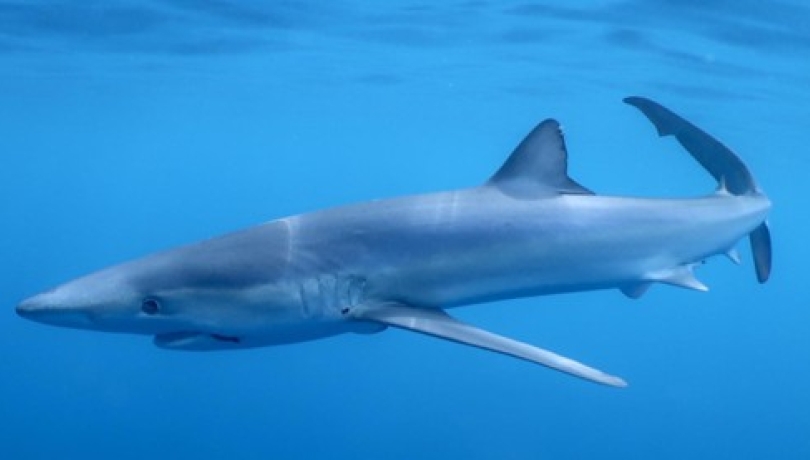
Researchers from the Institute of Marine Sciences (ICM-CSIC) and the National Museum of Natural Sciences (MNCN-CSIC) have identified the most important areas of the Spanish Western Mediterranean for the survival of sharks, one of the most threatened species on the planet. By combining the satellite tagging of live specimens with the analysis of biological samples from different shark species —blue shark, shortfin mako, and swordfish—, the research team analyzed the Mediterranean coast from Blanes to Cartagena, working closely with the fishing sector. The project, funded by the Biodiversity Foundation (Fundación Biodiversidad), reveals the importance of the submarine canyons off the Catalan coast, the waters of the Gulf of Alicante, and the coast of Almería for the feeding, reproduction, and migratory routes of large predators.
“One of the greatest values of the project has been the ability to integrate different scientific approaches and local stakeholders to better understand how these species move in the Mediterranean and which areas are especially relevant for their conservation,” explains Joan Navarro, researcher at the ICM-CSIC and scientific leader of the project.
In addition to being one of the most threatened groups of species on the planet according to the International Union for Conservation of Nature (IUCN), sharks, as apex predators —at the top of the food chain—, are key to the functioning of their ecosystems.
“Unfortunately, many populations are in decline and we still do not know many aspects of their ecology,” highlights Elena Fernández, an ICM-CSIC researcher linked to the project. “Having data on their movements and the connectivity between different areas is essential to progress toward more effective management and conservation measures,” she adds.
For the fieldwork carried out from Blanes to Cartagena, they relied on the close collaboration of the fishing sector, which worked on locating, catching, and releasing the tagged specimens, as well as collecting biological samples. The satellite tracking was conducted with specimens of the blue shark (Prionace glauca), a highly migratory pelagic shark; the deep-sea shark known as the bluntnose sixgill shark (Hexanchus griseus); and the ocean sunfish (Mola mola), one of the largest bony fish species in the world. Meanwhile, samples from the blue shark, shortfin mako (Isurus oxyrinchus), and swordfish (Xiphias gladius) were collected for genetic analysis.
“These analyses allow for a better understanding of the degree of connectivity between populations and help determine whether individuals are part of the same population or distinct groups—key information for defining conservation strategies at both regional and international scales,” notes Sergi Taboada, researcher at the National Museum of Natural Sciences (MNCN-CSIC).
According to Pablo Cermeño, a specialist in conservation programs at the Barcelona Zoo: “The involvement of the fishing sector has been fundamental to successfully developing the project, and most especially the tagging campaigns. Their experience and knowledge of the marine environment have contributed decisively to the fieldwork, demonstrating that collaboration between science and fisheries is essential for advancing ocean conservation.”
The COTI Project
This initiative is part of the COTI project, funded by the Biodiversity Foundation of the Ministry for the Ecological Transition and the Demographic Challenge through the Pleamar Programme. It is co-funded by the European Union via the EMFAF (European Maritime, Fisheries and Aquaculture Fund). The project seeks to make fishing compatible with the conservation of threatened pelagic sharks by identifying ecologically important areas in the North-Western Mediterranean. Coordinated by the Institute of Marine Sciences (ICM-CSIC), it involves the collaboration of the National Museum of Natural Sciences (MNCN-CSIC), Barcelona Zoo, and the Generalitat de Catalunya, among other entities.
With the conclusion of the project, the team hopes the data obtained will continue to generate new lines of research and help consolidate conservation strategies based on scientific evidence and cooperation between the scientific community, government bodies, and maritime sectors.