The REMO project, coordinated by REPSOL, has delivered key advances to ensure the safety of future geological storage of hydrogen and CO₂.
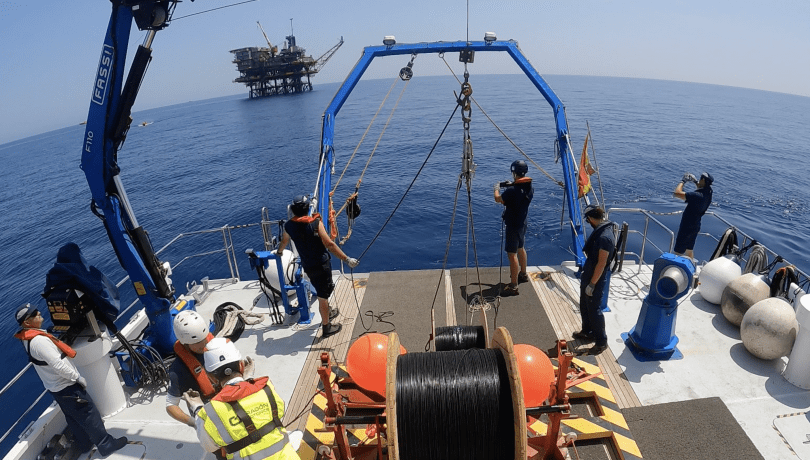
The REMO project, focused on developing new photonic technologies for seismic monitoring in marine environments, has successfully concluded, achieving very positive results. The initiative, carried out in collaboration between the Institute of Marine Sciences (ICM-CSIC), Repsol, the University of Alcalá (UAH) and Aragón Photonics, has enabled decisive progress in the application of optical fiber and distributed acoustic sensing to record natural and induced seismic activity. These advances represent a key step toward ensuring the safety of future geological storage of hydrogen and CO₂.
“Seismic analysis with optical fibres provides unprecedented resolution for detecting microseismicity in marine environments. REMO lays the groundwork for future monitoring systems that will be essential for the energy transition,” explains Arantza Ugalde, researcher at the Institute of Marine Sciences (ICM-CSIC).
Taking the pulse of the ocean
The REMO team has worked with distributed acoustic sensing (DAS) systems, which make it possible to use optical fiber cables, originally designed for telecommunications, as seismic sensors distributed over tens of kilometres. An optical interrogator sends light pulses through the fibre, detecting tiny deformations caused by seismic waves and converting them into thousands of measurement points spaced every few meters. This technology provides a high-resolution image of seismic activity without the need to install numerous individual underwater sensors, reducing costs and increasing operational reliability.
“The ability to monitor seismic activity with such precision will help optimize the safety and efficiency of future underground gas storage projects, aligning with our commitment to new technological development pathways in carbon capture, utilization and storage (CCUS) as part of Repsol’s decarbonization strategy,” notes Guillermo Marro, geophysicist at Repsol.
In addition, advanced artificial intelligence techniques have been integrated to process in real time the large volume of data generated by the DAS system, distinguishing relevant seismic signals from ocean noise.
“We have succeeded in integrating optical fibre sensors with advanced algorithms that enable reliable detection even in complex marine environments,” says Sonia Martín-López, researcher at the Institute of Optics (CSIC) and the University of Alcalá (UAH).
The experiment was carried out on the Casablanca platform in the Mediterranean Sea, about 50 km off the coast of Tarragona. There, the Casablanca-DAS Submarine Observatory was installed, using the platform that is currently undergoing decommissioning, as an ideal setting to validate the technology under real operating conditions.
“This project demonstrates that distributed fibre-optic monitoring can be implemented on a large scale for critical industrial applications,” adds Francisco López, CEO of Aragón Photonics.
Opportunities for the energy transition
To disseminate the results to the scientific and technological community, the Technical workshop on photonic technologies applied to marine seismic monitoring was held last week at ICM-CSIC. The hybrid event brought together more than 60 participants from research centres, technology companies and the energy industry. During the workshop, advances were presented in the instrumental development of the DAS system, its installation and offshore operation, as well as seismic analysis methods using optical fibre data.
With the conclusion of REMO, the team positions itself as a benchmark in the development of photonic technologies applied to monitoring the marine subsurface. The results will help improve the safety and efficiency of future geological storage projects, providing advanced scientific tools that support the transition toward a decarbonized economy.
The project showcases how collaboration between research centres, universities and technology companies can accelerate innovation, combining cutting-edge science, technological transfer and energy sustainability, and positioning Spain as a leader in this strategic field.