The scientific team, led by the ICM-CSIC, aims to further study the dispersion, evolution and adaptation of marine microorganisms in what is one of the environments most sensitive to global warming.
The Spanish Antarctic Campaign begins a new research season this Sunday on the white continent, one of the key regions for understanding how the global climate system operates. In this context, the first campaign of the POLAROMICS project gets underway. The project is jointly coordinated by the ICM-CSIC and the University of La Laguna and is funded by the Spanish State Research Agency (AEI).
Since the late 1980s, the Spanish Antarctic Campaign has been carried out uninterruptedly as a model of scientific and logistical cooperation in support of R&D&I. Coordinated by the Spanish Polar Committee, the campaign relies on unique scientific infrastructures such as the Spanish Antarctic bases Juan Carlos I (Livingston Island) and Gabriel de Castilla (Deception Island), as well as the oceanographic vessels BIO Hespérides and Sarmiento de Gamboa, which also provide logistical support for scientific activities.
Within the framework of POLAROMICS, led at the ICM-CSIC by Silvia G. Acinas and Pablo Sánchez Fernández, researchers will study how polar marine microorganisms disperse, evolve and adapt to a rapidly changing planet.
The poles, natural laboratories of global change
Polar regions play a fundamental role in regulating Earth’s climate, but they are also among the areas most vulnerable to global warming. Rising temperatures, the loss of sea ice and changes in ocean circulation are profoundly altering these ecosystems. In this context, marine microorganisms —the polar microbiome— emerge as key players: they form the base of food webs, drive ocean biogeochemical cycles and act as sensitive indicators of global change.
“The poles function as exceptional natural laboratories for studying how life responds to extreme conditions and rapid environmental change,” explains Silvia G. Acinas, principal investigator of POLAROMICS. “By studying the polar microbiome, we can detect early signals of the impacts of climate change and gain a better understanding of the processes that sustain ocean functioning.”
Although the Arctic and Antarctica are separated by thousands of kilometres, both systems are connected by an invisible network of microbial life. Deep ocean currents, atmospheric circulation and seabirds facilitate the dispersal of microorganisms between both ends of the planet. However, very little is still known about how these organisms disperse, diversify and adapt to polar biomes with very different environmental characteristics.
POLAROMICS aims to address these knowledge gaps by investigating three main aspects: the mechanisms of dispersal and ecological connectivity of polar microorganisms, their evolutionary diversification, and their adaptive strategies in response to environmental factors such as temperature, salinity, or the presence of mercury and other heavy metals.
“The rapid transformation of the poles is leading to a merging of ecological niches and the weakening of traditional biogeographical boundaries,” notes Pablo Sánchez Fernández, co–principal investigator of the project. “Understanding how microorganisms respond to these changes is key to predicting the resilience of polar ecosystems and their influence on the global ocean system.”
Two Antarctic islands to understand microbial adaptation
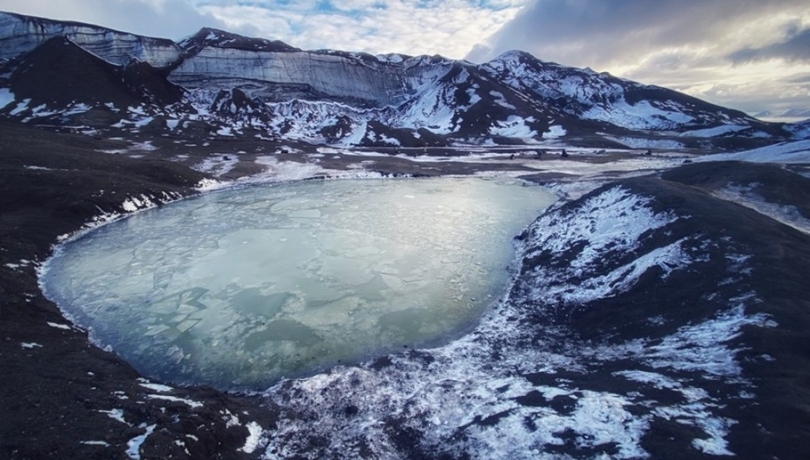
The first POLAROMICS campaign (2025–2026) will take place on two islands in the South Shetland archipelago with highly contrasting environmental characteristics. On Deception Island, an active volcanic caldera, researchers will sample marine waters, lagoons and lakes influenced by hydrothermal fumaroles, seismic activity and glacial melt —conditions that create extreme scenarios for microbial life. On Livingston Island, of tectonic and glacial origin and with no recent volcanic activity, the team will work in more stable ecosystems dominated by erosion and sedimentation processes.
“Comparing these two environments will allow us to understand how polar microorganisms are connected and adapt to very different conditions within the same geographical context,” says Acinas.
In total, eight researchers from the ICM-CSIC and the Institute of Marine Sciences of Andalusia (ICMAN-CSIC) will take part in the POLAROMICS campaign, carrying out their work at the Spanish Antarctic bases and aboard the BIO Hespérides.
The results of POLAROMICS will provide an unprecedented view of the polar microbiome in a scenario of accelerated change and will help improve models that predict how marine ecosystems respond to future climate scenarios. This knowledge is essential for better understanding and managing the nutrient fluxes and biogeochemical cycles that sustain life in the world’s oceans.