The species Mobydickia poseidonii, described based on a specimen recovered from the stomach of a sperm whale hunted in the 1950s, has been selected by the international register WoRMS as one of the ten most fascinating species discovered during the last year.
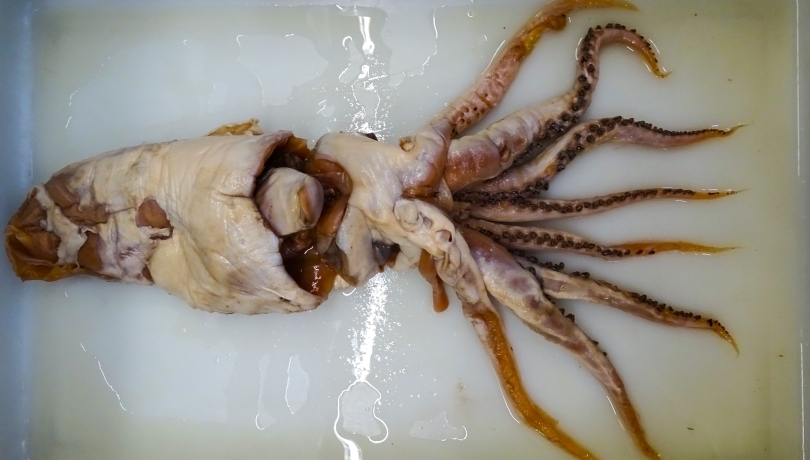
Coinciding with Taxonomist Appreciation Day, the World Register of Marine Species (WoRMS) has announced today its prestigious "Top Ten Remarkable Marine Species of 2025" list. Among this year’s most notable findings is Mobydickia poseidonii, a squid that not only represents a new species for science, but also a new taxonomic family—a milestone that has not occurred in the order of oceanic squids for 27 years.
Specifically, the discovery is the result of research led by Sam Arnold and Fernando Ángel Fernández-Álvarez (IEO-CSIC), conducted entirely at the Marine Biological Reference Collections (CBMR) of the Institut de Ciències del Mar (ICM-CSIC) in Barcelona, within the framework of Arnold's Master's Thesis (TFM).
A hidden treasure in the history of whaling
The story of Mobydickia poseidonii seems like something out of a 19th-century adventure novel. The original specimen on which the description is based (the holotype) was collected between 1955 and 1956, a time when whaling was still a legal and widespread practice. The specimen was extracted from the stomach contents of a cetacean and, for decades, remained preserved in the collection of Dr. Malcolm Clarke (1930–2013), an eminence in the study of cephalopods, before being deposited at the Natural History Museum in London (NHM).
For nearly 70 years, the squid was misidentified as part of a complex of already known species (Ancistrocheirus lesueurii). However, the meticulous review carried out by Arnold and Fernández-Álvarez in the ICM-CSIC laboratories revealed that they were facing something completely different.
"The morphology of this specimen was so radically different from any previously described squid that the creation of a new family was inevitable," the authors explain. The genus name, Mobydickia, honors Herman Melville’s famous white whale, because the squid's body lacks pigmentation and was found in the belly of a sperm whale. The specific epithet, poseidonii, pays tribute to the Greek god of the sea, as the hooks on its arm suckers have lateral cusps reminiscent of the shape of a trident.
The importance of scientific collections
This find underscores the incalculable value of scientific-technical infrastructures such as the Marine Biological Reference Collections (CBMR) of the ICM-CSIC. These are dynamic archives of Earth's biodiversity that contain answers to questions the scientific community has not yet formulated.
"It is a fortunate paradox," the researchers note, adding:
"Although today we celebrate that humanity respects and protects cetaceans, the material collected in that era of industrial hunting, if properly preserved and curated, offers unique opportunities. Marine predators like sperm whales are, by evolution, much better samplers of rare squids than any technological device we can create. This highlights the relevant role that scientific collections play in enabling research that would otherwise be impossible today."
Finally, the scientific team emphasizes the importance of maintaining high-quality biological reference collections like those at the ICM-CSIC and advocates for continued investment in modern taxonomy, which combines detailed morphological observation with the critical analysis of historical data, as it remains a fundamental pillar for understanding ocean health and diversity.
A milestone for science
Recognition from WoRMS places the ICM-CSIC at the forefront of global marine biodiversity. The research also involved collaboration with the Spanish Institute of Oceanography (IEO) and the Natural History Museum in London, reflecting the importance of international cooperation in the study of the deep sea.
The inclusion of Mobydickia poseidonii in the Top 10 of fascinating new marine species of 2025 is not just an award for scientific curiosity, but a reminder that we still know very little about what inhabits the deep ocean. While technology advances, the taxonomist's "clinical eye" and the conservation of specimens in collections like those of the ICM-CSIC remain the most powerful tools for unveiling the mysteries of the ocean. Lastly, the discovery reflects the importance of exchanges between scientific collections: if the M. poseidonii specimen had not been sent to the ICM-CSIC from the NHM, this discovery would not have happened.