In this month’s “In Depth” feature, we explore how the biological awakening of phytoplankton is facing the challenges of the climate crisis and the physical transformation of coastal areas.
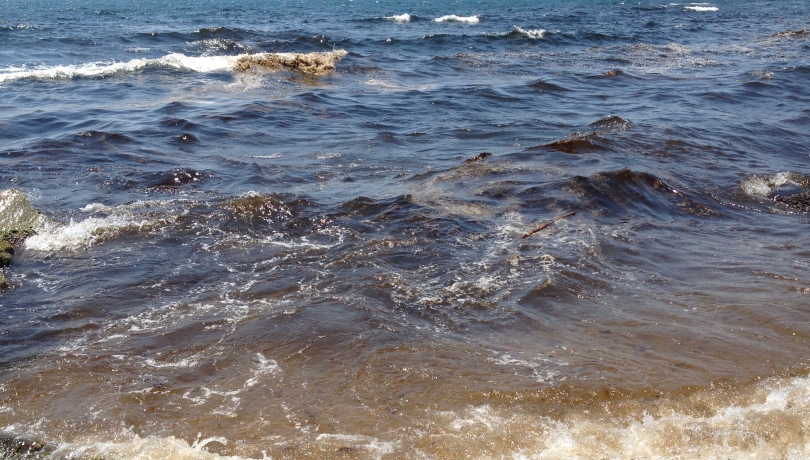
The oceanographer Sylvia Earle reminds us that with every breath we take, we are connected to the sea. This is not an empty statement: half of the planet’s oxygen is produced by phytoplankton, this tireless microscopic community that, every spring, drives one of the most important biological phenomena on Earth. While nature blooms on land, the ocean experiences the spring bloom as well—an explosion of life that marks the beginning of annual productivity and that explorers such as Jacques Cousteau once described as the invisible engine of the underwater life.
This phenomenon follows a precise physical mechanism that begins during the colder months. In winter, surface water cools, becomes denser, and sinks, triggering large-scale vertical mixing. This movement acts like an elevator, bringing essential nutrients—nitrate and phosphate—from deep layers up to the surface.
With the arrival of spring, the final trigger is light availability: longer days increase photosynthesis, and solar warming creates a lighter surface layer that floats and “traps” phytoplankton, providing both light and nutrients. In oceans such as the North Atlantic, phytoplankton blooms can be very extensive due to higher nutrient availability. In the Mediterranean, although production is more variable and often lower due to nutrient limitations, it remains crucial for sustaining marine life, including large vertebrates such as whales.
Changes driven by new coastal threats
However, this natural rhythm is undergoing significant alterations. At the ICM, some researchers are focusing on how human activity and climate change are reshaping these cycles into more complex scenarios. We are no longer observing only beneficial diatom blooms that feed fish; harmful algal blooms (HABs) are now occurring more frequently. Particularly along the coast, these blooms are no longer driven solely by natural winter nutrient mixing, but also by excess nitrogen and phosphorus discharged into the sea through agriculture and human activity.
One of the most emblematic cases studied is the microalga Ostreopsis. Unlike classic phytoplankton that floats freely in the water column, Ostreopsis is a benthic dinoflagellate: it lives on top of macroalgae and rocks in shallow waters. Traditionally tropical, this microalga has found an ideal new habitat in the “tropicalization” of the Mediterranean. Warming waters and human infrastructures such as ports and breakwaters—which alter water and sediment circulation—create the perfect breeding ground for its populations to grow excessively during the heat of summer.
The link between marine ecology and public health
The presence of these microalgae is not merely a biological curiosity or an isolated phenomenon; it has a direct and tangible impact on society. Several studies led by the Institute, especially in areas where Ostreopsis blooms occur annually, have established a clear link between these events and various health issues that often go unnoticed or are mistaken for seasonal illnesses. When these algae proliferate, they can cover the seafloor with a brown mucilaginous layer that disrupts local ecosystems, and the risk to humans arises through both the air we breathe near the sea and direct contact with seawater.
Through wave action, the toxins produced by the algae become incorporated into marine aerosols. Winds carry them toward the coast, where they can be inhaled by swimmers, workers, or passersby. Research by the ICM in collaboration with epidemiologists confirms that exposure to these aerosols causes acute symptoms: respiratory irritation (coughing, nasal congestion), eye irritation, and, in more severe cases, fever approaching 38 °C and general malaise. These effects resemble a cold or mild flu but appear suddenly on a sunny beach day and disappear shortly after leaving the affected area, leaving behind an invisible yet concerning trace of marine imbalance.
This reality forces us to rethink our relationship with coastal environments in a much deeper way. Oceanic spring can no longer be seen solely as a bucolic cycle of biological renewal, but rather as a precise and unsettling indicator of ecosystem health. Globalization, through e.g., ship ballast water, has facilitated the spread of these species worldwide, and our coastal management model—often prioritizing artificial beach stability over natural dynamics—has further encouraged their excessive proliferation.
As Sylvia Earle puts it, there is no “out there” when we talk about the ocean; what happens just a few meters from our towel, in this microscopic world awakened by light, reflects a global change that directly affects human health. In this context, ICM research not only provides data but also shows that understanding these cycles is our best tool for coexisting with a changing environment. Ultimately, understanding the ocean’s pulse is the only way to protect this blue giant that, despite our pressures, still generously provides half of every breath we take.