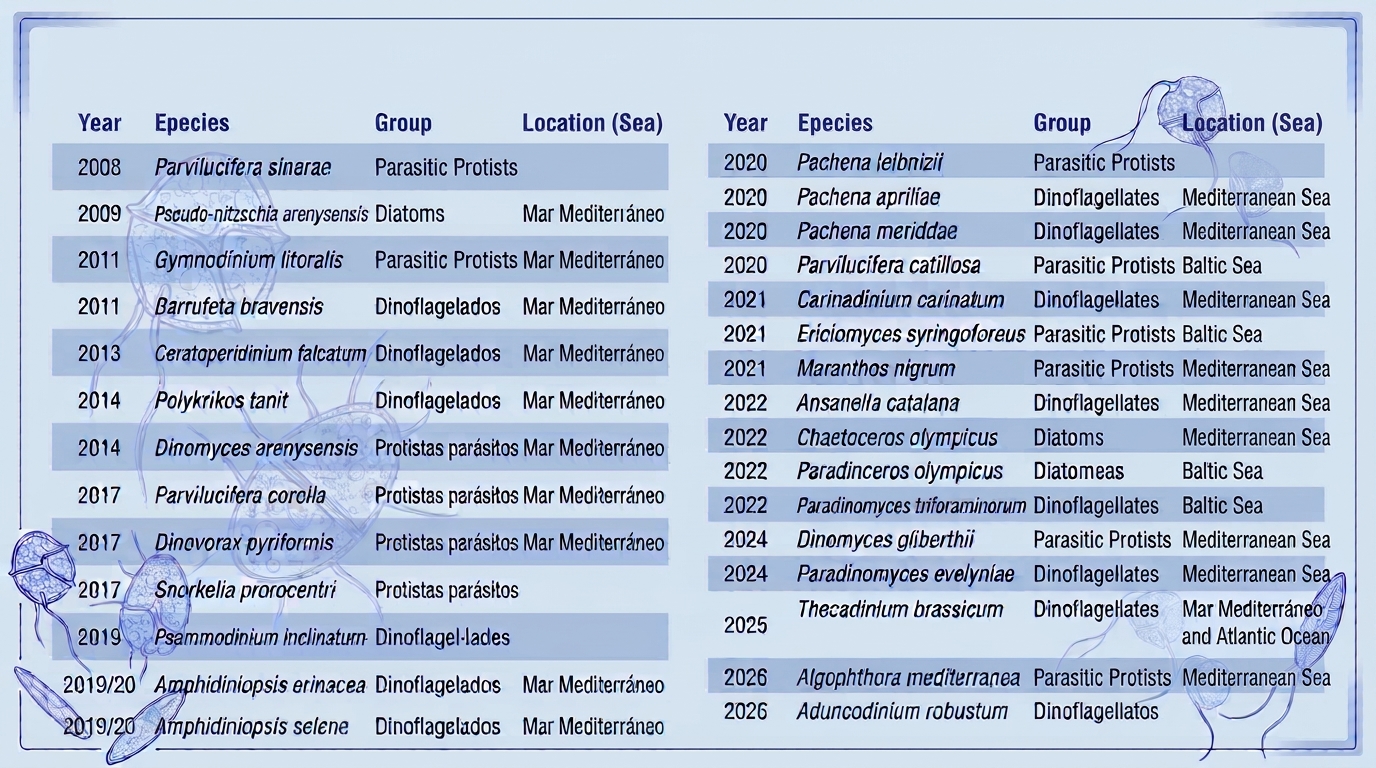
In this month's 'In Depth' section we talk about how the discovery of 24 species of microorganisms in the Mediterranean expands the biodiversity we know and reveals key relationships among marine organisms.

Every 10th November, the celebration of World Science Day invites us to pause and remember the essence of research: curiosity in the face of the unknown. We tend to imagine scientific discovery as an expedition to remote lands, the descent into the darkest abysses of the ocean, the observation of distant galaxies, or the search for invisible particles in large laboratories, but often the frontier of knowledge unfolds just a few meters from our coast: a single drop of water from a beach can contain as-yet-unknown life. We often talk about the biodiversity we are losing, but there is also much that we are only just beginning to know. Each described species makes visible a part of this life that was already there and that we did not yet know how to recognize.
This gap in knowledge is especially large in the microscopic realm of plankton. Marine microorganisms, such as microalgae or parasites, form an invisible fabric that sustains the ocean's biogeochemical cycles and articulates the trophic web. However, a substantial part of this living architecture remains unnamed. Since 2008, the Coastal Biological Processes group at the Institute of Marine Sciences (ICM-CSIC) has dedicated itself to identifying and describing this diversity, introducing species new to science.
Discoveries right on our doorstep
These species were not found in unexplored seas, but on the coasts of the Mediterranean, one of the most studied basins on the planet. How is it possible that they have gone unnoticed until now? The answer lies in the subtlety of nature. We are talking about organisms that measure a few microns, and which we often only detect sporadically. Continuous monitoring is essential to detect this elusive biodiversity. It is therefore necessary to return time and time again to the same coastal spots, observe community changes, and combine advanced microscopy with laboratory cultures and genetic sequencing tools to identify these microorganisms.
Among the findings of these nearly two decades are species of great ecological relevance, such as certain dinoflagellates, diatoms, and, very specially, parasitic protists. These discoveries not only expand the catalog of known species; they also allow us to study the relationships among organisms and better understand the functioning of plankton. Parasitoids —such as Parvilucifera sinerae, described in 2008, or representatives of the genera Dinomyces and Paradinomyces— play a key role: they infect microalgae, regulate their populations, and modify the fate of organic matter within the ecosystem.
Names with history: poetry and the environment behind science
Naming a new species requires following the rules of scientific nomenclature, but it often hides touches of humor, territory, and personal tributes. The etymology of these microorganisms brings us closer to the history behind each discovery. One of the most illustrative cases is Barrufeta bravensis, a dinoflagellate whose appearance reminded researchers of the Smurfs' traditional red cap ("barretina"), while its specific epithet pays tribute to the Costa Brava, where it was found.
On the other hand, local geology and Catalan literature have also left their mark on marine taxonomy. The parasite Parvilucifera sinerae, for example, is named in homage to the myth of Sinera created by the poet Salvador Espriu, referring to the town of Arenys de Mar, where the samples were collected. Other species make direct reference to their habitat or morphological peculiarities, demonstrating that naming microscopic life is also a way to connect rigorous science with the culture and territory that surrounds us.
The importance of basic science
Describing a species means giving it an identity that allows us to recognize it, study where it lives, how it proliferates, and what relationships it establishes with other organisms. In this sense, we also gain biodiversity by getting to know it: not only because the number of species in the sea increases, but because we expand the diversity we know how to recognize and study. This gain in knowledge does not compensate for species loss, but it has value in its own right. In a Mediterranean subject to pressures, it also provides us with a more complete baseline to interpret environmental changes.
The 24 species described since 2008 are the result of nearly two decades of rigorous observation and interdisciplinary collaboration, and they show that there is still much to discover right on our doorstep. Environmental sequencing techniques reveal genetic fingerprints that we cannot yet associate with identified and described organisms. Connecting these molecular data with specific life forms and ecological functions is one of the major scientific challenges of the coming years.