The research, led by the Institute of Marine Sciences (ICM-CSIC), reveals that turtles dive with their lungs partially inflated to maintain buoyancy in shallow waters, which could reduce their oxygen reserves if they become trapped in fishing gear.
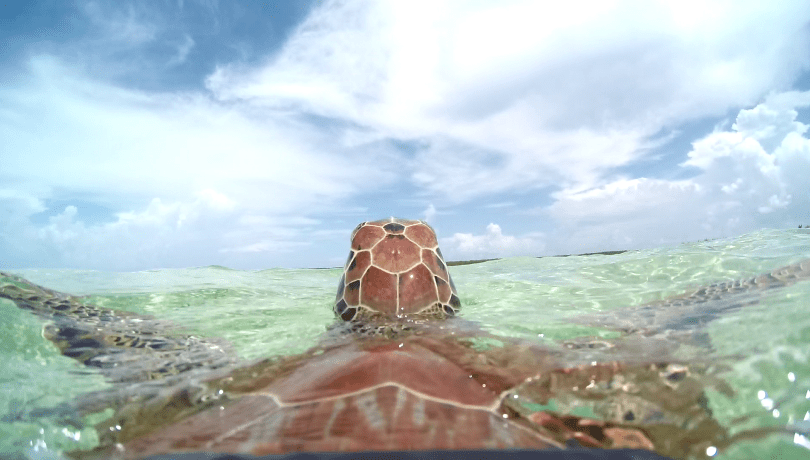
A new study led by the Institute of Marine Sciences (ICM-CSIC) has provided new data on the diving behaviour of juvenile green turtles in shallow habitats, an environment that is key but still little studied in the life cycle of this species. The research, recently published in the journal Marine Ecology Progress Series, analyses how these turtles use waters of less than five metres in depth in the Bahamas and points to possible implications for the conservation of the species, especially in relation to accidental catches in fisheries.
Green turtles (Chelonia mydas) spend a large part of their juvenile phase in shallow coastal habitats, where they find food and shelter. However, most studies on their diving behaviour have focused on deeper waters. To address this gap in knowledge, the research team used cameras attached to the animals and temperature and depth recorders to directly observe how they move and how they manage dives in these environments.
“Very shallow habitats are fundamental for the development of young green turtles, but surprisingly, we still know relatively little about how they use space there or how they breathe and dive there,” explains Ruth Doñate-Ordóñez, one of the authors of the study. “With camera and sensor technology, we have been able to obtain a much more detailed view of their real behaviour.”
Shallow habitats
The results show that dives in these environments are relatively short, with an average duration of around 1.5 minutes. In addition, the team observed that the duration of dives increased with depth and with the time that the turtles spent at the surface before diving again. By contrast, water temperature did not show a significant influence on dive duration.
The analysis of the behaviour recorded by the cameras also revealed a clear relationship between the type of activity and the duration of the dive. The shorter dives tended to be associated with active behaviours, such as swimming or feeding, whereas the longer dives were mainly linked to periods of resting on the seabed.
According to the research team, these patterns could be related to the way in which turtles regulate buoyancy in shallow waters. In deep waters, turtles can completely inflate their lungs before submerging, which provides them with large oxygen reserves but also makes them tend to float. By contrast, in very shallow waters, this may make it more difficult to remain close to the bottom.
“Our results suggest that turtles may dive with their lungs only partially inflated to maintain neutral buoyancy,” explains Ruth Doñate-Ordóñez. “This would allow them to remain near the seabed with less effort while feeding or resting.”
Implications for conservation
This behaviour could have important implications for better understanding the risks associated with accidental catches in fisheries. Accidental capture — known as bycatch — is one of the main threats to many species of sea turtles around the world.
If turtles dive with their lungs only partially inflated, the amount of oxygen available during the dive may also be lower. Consequently, if an animal becomes trapped underwater in a net or other fishing gear, it may have less time before exhausting its oxygen reserves.
“If this hypothesis is confirmed, turtles caught in shallow habitats may drown more quickly than those trapped in deeper waters,” notes Nathan Robinson, another of the study’s authors. “This highlights the importance of understanding how they use these environments.”
For the authors of the work, understanding how turtles use coastal habitats can help to design more effective management and conservation strategies. “Knowing the diving behaviour in these ecosystems helps us to identify when and where they may be more vulnerable to human activities,” they explain. “This information is key to developing measures that reduce accidental catches.”
The research also demonstrates the potential of new technologies for studying marine animals in the wild. Cameras carried by the animals, combined with environmental sensors, make it possible to observe behaviours that until recently were difficult to study in detail.
“We increasingly have more sophisticated tools to see the world from the animals’ perspective,” highlights a member of the team. “This not only improves our scientific knowledge, but can also have a direct impact on conservation.”
Green turtles are classified as a threatened species in many regions of the world, although some populations have shown signs of recovery thanks to decades of conservation efforts. Nevertheless, they continue to face multiple pressures, such as habitat loss, pollution, and accidental capture.
According to the research team, future research could expand these results by analysing other populations or comparing diving behaviour in different types of habitats. They also highlight the need to integrate this information into fisheries management and conservation policies.
“Protecting sea turtles requires an in-depth understanding of how they use their environment. Studies like this provide key pieces of the puzzle and help us move towards a more sustainable coexistence between human activities and marine biodiversity,” they conclude.